Programme :
Lectures :
- Michelle Chu (University of Minnesota Twin Cities): Arithmetic hyperbolic manifolds.
- Gregor Masbaum (CNRS, IMJ-PRG): Quantum representations and integral structures.
- Ana Rechtman (Université Grenoble Alpes): On the existence of periodic orbits.
Special talk :
- Benjamin Audoux (Aix-Marseille Université): Quantum codes and topology.
Download full School Program:
[WBXV pdf file]Schedule:
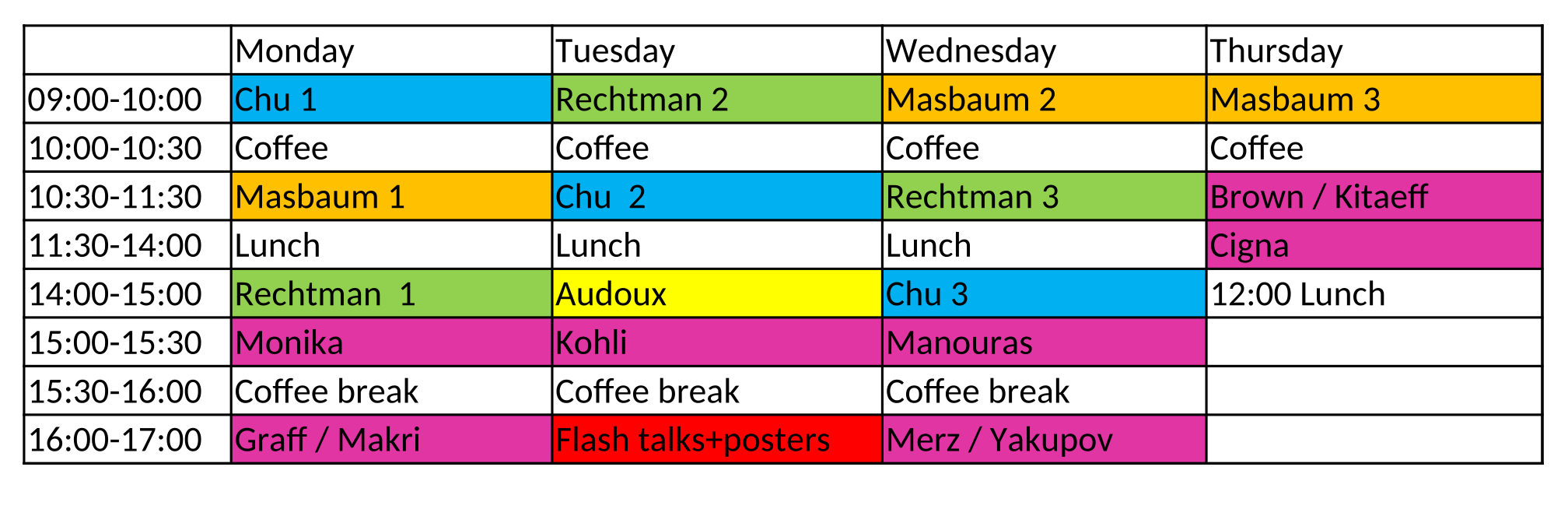
Abstracts :
Arithmetic hyperbolic manifolds
Michelle Chu (University of Minnesota Twin Cities)In this mini-course I will introduce the study of arithmetic hyperbolic manifolds. These manifolds are constructed using quaternion algebras and quadratic forms, and their geometric and topological structures reflect their arithmetic and number theoretical properties. I will introduce the construction of such manifolds and discuss several geometric properties of arithmetic hyperbolic manifolds. I will also discuss the geometric and algebraic dichotomy between arithmetic and non-arithmetic manifolds.
Integral Structures in TQFT and applications
Gregor Masbaum (CNRS, IMJ-PRG)Following Atiyah and Segal, a (2+1)-dimensional TQFT consists of (1) numerical invariants of closed 3-manifolds, (2) vector-valued invariants of 3-manifolds with boundary, and (3) finite-dimensional representations of mapping class groups of surfaces, whith all three sets of invariants interrelated through various axioms. In this mini-course, we will focus on Witten-Reshetikhin-Turaev SO(3)-TQFT at roots of unity of prime order. We will describe this TQFT from scratch, using the skein theory of knots and links in 3-manifolds. We will then see that this TQFT has an integral structure, meaning that in the appropriate normalization, the 3-manifold invariants are algebraic integers, and so are the coefficients of the mapping class group representations. This leads in particular to mapping class group representations into arithmetic groups with interesting properties. The aim of this mini-course is to explain how this works and to discuss some applications of this integral structure both in low-dimensional topology and to mapping class groups.
On the existence of periodic orbits
Ana Rechtman (Université de Grenoble)This minicourse will focus on the following (old) question: given a flow without fixed points on a closed manifold, does it have periodic orbits? For the question to make sense, the Euler characteristic of the manifold has to be equal to zero. The question can then be specified in many ways: type of manifold, differentiability class of the flow and manifold, properties preserved by the flow. The quest of periodic orbits began with the work of Poincaré. In view of the Poincaré-Lefschetz theorem one could expect that the topology of manifold forces the existence of periodic orbits. We now know that this is only true in dimension 2, it follows from work of Wilson and Kuperberg that in dimension bigger or equal to three every manifold admits a flow without periodic orbits. On the other hand, there are some classes of flows that always admit periodic orbits. We will review some of the results on the existence and non-existence of periodic orbits for flows, and discuss open questions in particular for volume preserving flows.
Quantum codes and topology
Benjamin Audoux (Aix-Marseille Université)Error correction is the art of encoding data in such a way that small errors (that might occur during transmission or storage) can be detected and corrected. Important in the classical setting, it is even more essential in quantum setting because of natural quantum decoherence. In my talk, I will explain how error correction can be done for quantum information and how topology can help. I will indeed focus on the case of CSS codes which are very closely related to chain complexes.